Mockup Overview
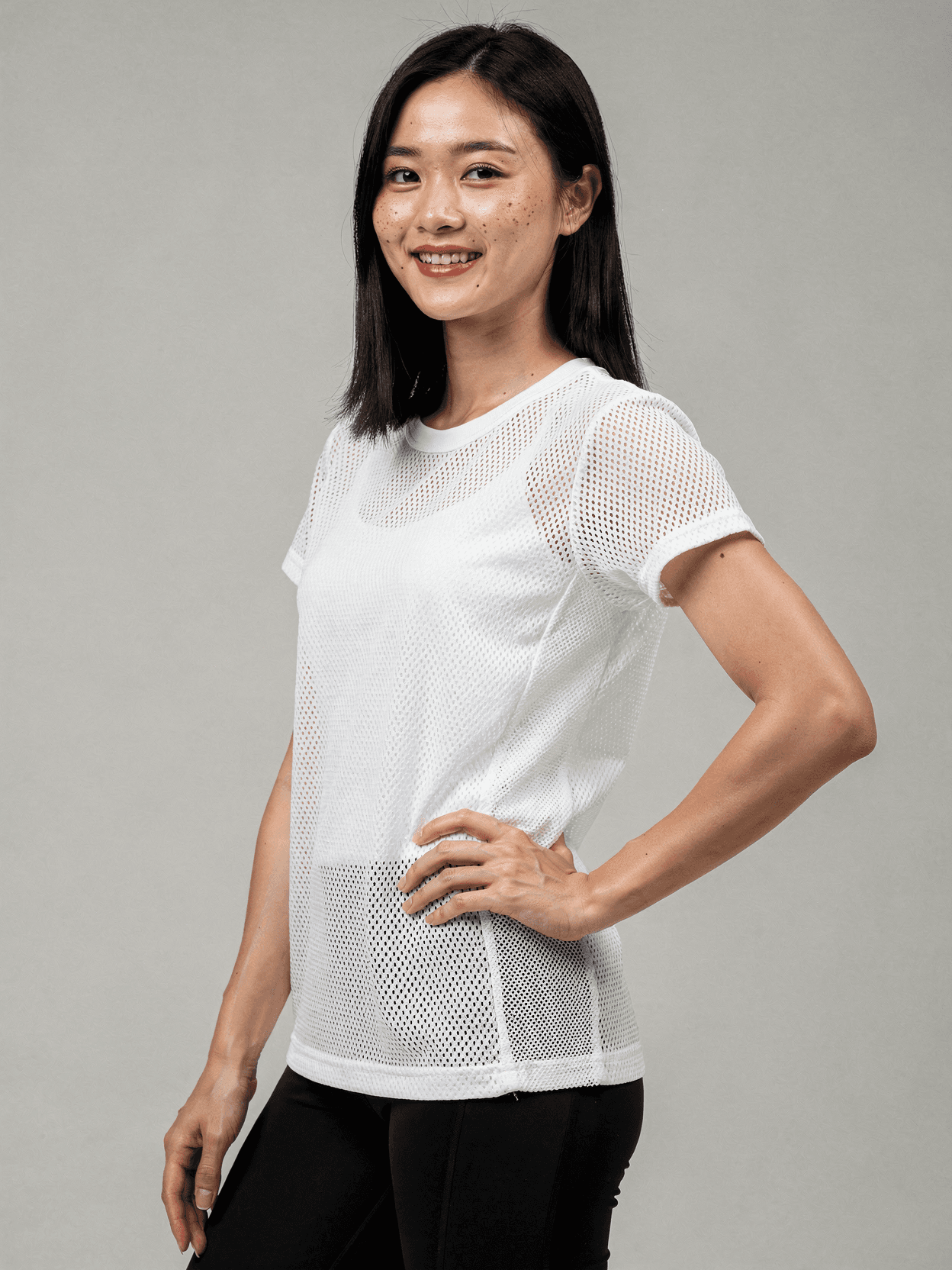
This mockup template shows a white mesh jersey on a female model photographed in a minimal studio environment. The model is a young East Asian woman with straight, shoulder-length black hair, natural freckles across her cheeks and nose, and a lean, athletic build. She is shown across six camera angles against a neutral light gray background with soft, even studio lighting. The jersey is a short-sleeve crewneck design constructed from an open mesh fabric with a visible honeycomb-pattern weave throughout. The garment features a relaxed, slightly boxy fit that sits at the hip, with a solid ribbed crewneck collar and hemmed short sleeves.
What This Mockup Shows
The primary three-quarter front view captures the model at roughly a 45-degree angle, smiling with her left hand on her hip. The mesh texture is clearly visible across the shoulders, sleeves, and lower hem, where the fabric becomes semi-transparent. She wears black leggings underneath, and through the lower portion of the jersey the dark fabric beneath is visible, demonstrating how the mesh weave interacts with layered garments.
The front centered view shows the model facing the camera directly with arms at her sides. A white inner layer (visible as a scoop-neck camisole or sports bra) is apparent beneath the mesh. The chest area where the inner layer sits appears more opaque, while the shoulders, upper chest, and hem section remain sheer. This view is paired with black cycling shorts.
The back view shows the model facing away with both hands on her hips. The back panel is entirely mesh with no inner lining, making the model's skin and undergarment straps visible through the fabric. Vertical seam lines run down the center back. The jersey hem hangs evenly at the hip.
The action pose captures the model mid-stride in a running motion, hair swept back by movement. She wears black full-length leggings. The jersey drapes naturally during motion, and the mesh fabric shifts slightly with the body's movement, showing how the garment behaves during physical activity.
The detail closeup focuses on the chest and neckline area. The honeycomb mesh pattern is clearly defined at this magnification, with individual openings in the weave visible. The ribbed crewneck collar binding is smooth and sits flat against the skin. The model's hand rests lightly on the chest area.
The side profile view shows the model from the left side with arms crossed. The jersey's relaxed silhouette is apparent from this angle. The short sleeve ends just above the bicep. The hem falls straight without tapering, and the side seam construction is visible.
Technical Details
The jersey's white base color provides the blank surface for design rendering. Because the mesh fabric has a pronounced open-weave texture, designs rendered via SudoMock's API will show texture bleed-through when using Multiply blend mode, creating a realistic printed-on-mesh appearance. The solid white areas (where the inner layer sits in the chest region) will render designs more opaquely, while the sheer mesh sections will allow background visibility.
This template is compatible with SudoMock's PSD rendering pipeline at $0.002 per render. Users upload their jersey designs through the REST API or the Dashboard Playground, and the engine composites artwork onto the Smart Object layers. The six available angles allow generation of a complete product catalog set from a single design upload.
Intended Applications
This template is suitable for e-commerce product listings on platforms such as Shopify and WooCommerce. Print-on-demand sellers using Printful, Printify, or Gelato can use these rendered outputs for storefront imagery. The mesh construction makes this template applicable to athletic jerseys, workout tops, and sports team apparel visualization. The multiple angles provide enough coverage for marketplace listings that benefit from front, back, and detail photography.
The open mesh fabric differentiates this from solid jersey templates. Designers working on football jerseys, training tops, or layered athletic wear can evaluate how their graphics interact with a perforated textile surface before committing to production runs.